- performance-tree
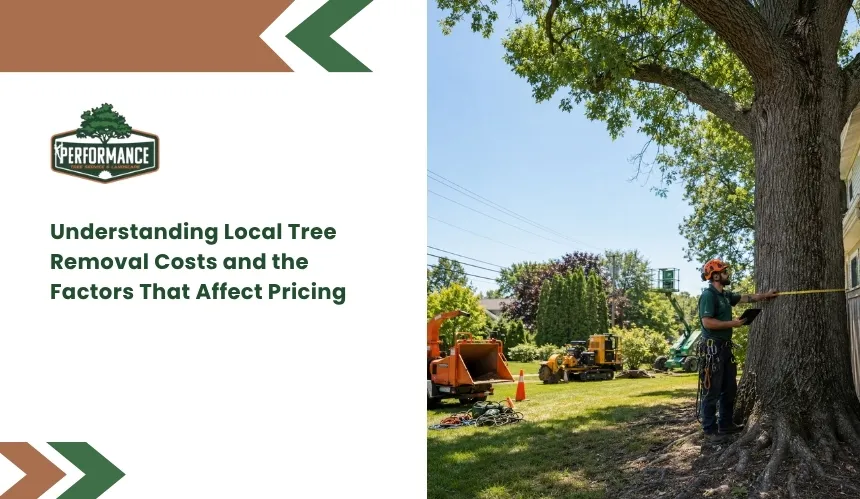
Understanding Local Tree Removal Costs and the Factors That Affect Pricing
Tree removal costs can vary significantly from one area to another. While tree size plays an important role, local labor rates, equipment availability, property conditions, and regional demand can all influence the final price.
Many homeowners search for tree removal costs in their area because online averages often provide broad national ranges that do not always reflect local conditions. A tree that costs one amount to remove in one region may cost considerably more or less in another.
This guide explains why tree removal pricing varies by area, how tree size and property conditions affect costs, and what homeowners can do to obtain a more accurate local estimate.
Why Tree Removal Costs Vary by Local Area

Tree removal prices vary by city or region. Even similar trees can have different costs depending on local labor rates, equipment availability, permit requirements, and overall demand for tree services.
This is why national averages should only be viewed as general guidelines. Local conditions often have a significant impact on the final estimate.
How regional labor rates affect tree removal pricing
Labor costs vary from one area to another based on the local market and cost of doing business. Areas with higher operating expenses or greater demand for skilled tree crews often have higher removal costs. Because labor represents a major portion of the project, regional differences can noticeably affect the final price homeowners receive.
Why local equipment access and crew availability matter
Tree removal companies rely on specialized equipment and trained crews to complete projects safely. In some areas, equipment availability, travel distances, and scheduling demand can influence pricing. During busy seasons or after severe weather events, increased demand for tree services may also affect how quickly crews are available and how much emergency work costs.
How Tree Size Changes the Cost in Your Area
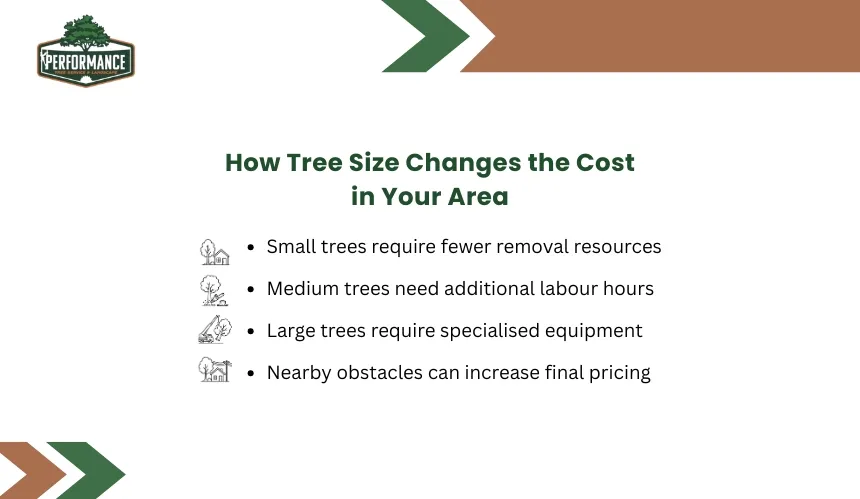
Tree size remains one of the biggest factors affecting local removal costs. Larger trees require more labor, additional safety precautions, and specialized equipment, which naturally increases pricing regardless of location. Although local rates vary, tree height and overall size still play a major role in determining the final estimate.
Small tree removal cost for local residential properties
Small trees under approximately 30 feet tall are generally the least expensive to remove because they require less labor and fewer resources. In many areas, homeowners can expect small tree removal to range from $150 to $500. The exact price depends on local labor rates, accessibility, and the condition of the tree.
Medium and large tree removal cost in nearby neighborhoods
Medium trees between 30 and 60 feet tall often cost $400 to $1,000, while large trees over 60 feet tall typically range from $800 to $2,500 or more.
Trees located near homes, garages, fences, or power lines may exceed these ranges because additional equipment and more controlled removal methods are often required. Local site conditions can significantly influence the final cost.
How Property Conditions Affect Local Tree Removal Prices
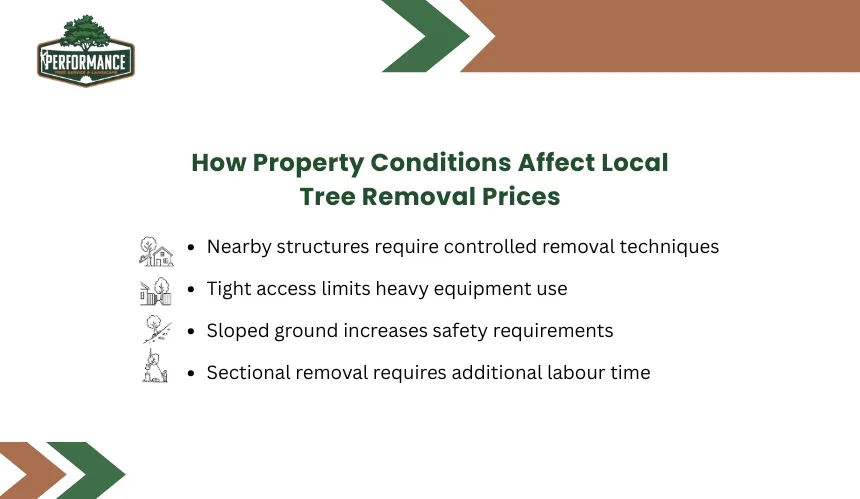
The condition and layout of the property can have a major impact on tree removal costs. Even two trees of similar size may have very different prices if one is easy to access and the other requires more complex removal techniques.
Obstacles around the tree often increase labor time and may require additional safety measures or specialized equipment.
Trees near homes, fences, driveways, or utility lines
Trees located close to structures require more controlled removal methods to avoid damage. Nearby roofs, sheds, fences, driveways, and utility lines can limit how branches are removed and increase the complexity of the project.
Because additional planning and precision are required, removals near property improvements are often more expensive than trees located in open areas.
Limited access, slopes, and tight backyard spaces
Access limitations can also affect pricing. Narrow side yards, steep terrain, retaining walls, and fenced properties may prevent crews from using larger equipment.
When machinery cannot easily reach the work area, crews may need to remove the tree in smaller sections, increasing labor time and overall project costs. These site-specific challenges often explain why local estimates can vary significantly from one property to another.
How Storm Damage and Emergency Requests Affect Area Pricing

Storm damage and emergency situations can increase tree removal costs beyond standard pricing. Trees that are broken, leaning, partially fallen, or creating immediate hazards often require faster response times and additional safety precautions. Because these situations are less predictable, emergency work is usually more complex than routine tree removal.
Why urgent tree removal costs more after severe weather
Following major storms, demand for tree services often increases throughout the area. Tree companies may receive a large number of service requests within a short period, which can affect scheduling and emergency response availability.
Urgent projects frequently require crews to work under more hazardous conditions, which may increase labor requirements and overall costs.
How fallen or leaning trees change the removal estimate
Storm-damaged trees can become unstable and difficult to remove safely. Broken limbs under tension, partially uprooted trees, and trees resting on structures often require specialized techniques and equipment.
Because these situations involve greater risks, the final estimate may be higher than a standard removal. The complexity of the damage usually determines how much additional work is required.
How to Get an Accurate Tree Removal Quote in Your Area
The most accurate tree removal estimates are based on the specific conditions of the property rather than national averages. Online price ranges can provide a general idea, but every tree removal project has unique factors that influence the final cost.
Why local on-site inspections give better estimates
An on-site inspection allows tree professionals to evaluate tree height, trunk size, accessibility, nearby structures, and any safety concerns. These details are difficult to assess accurately through generic pricing charts alone. Because local conditions vary from property to property, a physical inspection often produces the most dependable estimate.
What details homeowners should provide before requesting pricing
Providing basic information in advance can help tree companies prepare more accurate quotes. Helpful details include:
- Approximate tree height
- Whether the tree is dead, leaning, or storm-damaged
- The tree’s location on the property
- Nearby structures, fences, or utility lines
- Whether stump grinding is requested
- Photos of the tree, if available
Sharing this information early allows local tree professionals to better understand the scope of the project and recommend the appropriate equipment and services.
Frequently Asked Questions
How much does tree removal usually cost in most areas?
Tree removal costs vary by location, but many residential projects range from $150 to $2,500 or more. The final price depends on tree size, accessibility, local labor rates, and the complexity of the removal.
Why do tree removal prices differ between areas?
Labor costs, equipment availability, permit requirements, and regional demand can all affect pricing. Two similar trees may have different removal costs simply because they are located in different areas.
Does a larger tree always cost more to remove?
Generally, yes. Larger trees require more labor, additional safety precautions, and specialized equipment. Trees over 60 feet tall often cost significantly more than smaller trees.
Do trees near homes or power lines increase removal costs?
Yes. Trees located close to structures, fences, driveways, or utility lines usually require more controlled removal methods and additional safety measures, which can increase pricing.
How can homeowners get the most accurate tree removal estimate?
An on-site inspection typically provides the most reliable estimate. Providing photos, tree size information, and details about nearby structures can also help tree companies prepare more accurate quotes.